W
Willowbrook Water and Sanitation - Welcome


Home
Rates and SurchargesTap Fees and PermitsDrought InformationFacts and Figures
Main Break Information
Plumbing Tips
Xeriscape
Conservation TipsBoard MeetingsLinksContact Us


Drought Information


Is Your Lawn Too Far Gone?
Taking Care of Trees During the Drought


WATERING RESTRICTIONS ...

2008 Summer Watering Rules and Tap+Smart Tips

Denver Water’s 2008 Summer Water Use program is effective May 1 to September 1.

Colorado’s snow-packed mountains will fill our reservoirs, but remember that we live in a semiarid climate and must use water wisely. Enclosed are watering rules, times, tips and tools to help you use only what you need.

Tap+Smart is the name of Denver Water’s plan to accelerate the pace of water conservation in its service area and reduce overall water use from pre-drought usage (2001) by 22 percent by 2016.

Join Denver Water and make conservation a normal way of life today. By joining our efforts and becoming Tap+Smart, you can help ensure sufficient water supplies for future generations.

Watering Rules

In 2008, Denver Water will be stepping up enforcement of watering rules, so please use water wisely.

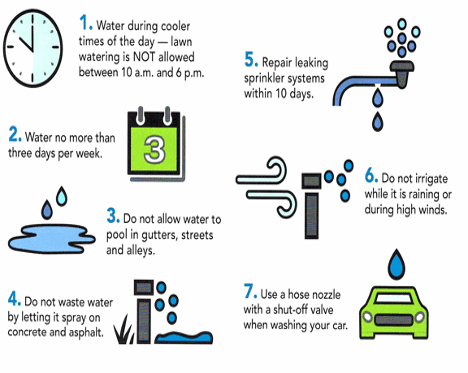
  • Water during cooler times of day - NO lawn watering is allowed between 10 a.m. and 6 p.m.

  • Do not allow water to pool in gutters, streets and alleys.

  • Do not waste water by letting it spray on concrete and asphalt.

  • Repair leaking sprinkler systems within 10 days.

  • Do not use spray irrigation while it is rain or during high winds.

  • There are no assigned watering days, but watering more than three days per week is prohibited.

REPORT WATER WASTE

If you see water waste, call 303-986-2275.

These rules are mandatory.

Penalties are:

1st violation – warning

2nd violation - $50 fine

3rd violation - $100 fine

Continued violations can result in suspension of service.

Watering Days & Times

Recommended watering times change as summer weather heats up and then cools down. Watering two days a week should be sufficient during most of the summer. If needed, a third watering day can be added in extreme heat or during dry periods.  Remember, there are no assigned watering days. 

Use Only What You Need

Here are some simple tips for outdoor watering to help you use only what you need.

1. Check soil moisture before you water.

Your lawn may not be as thirsty as you think. Tip: Walk across your lawn. Look back for footprints. If you don’t see any, no water is needed.

2. Change the time setting on your automatic controller each month.

Once a month, adjust the clock on your irrigation system to the correct watering times (see chart). You can maintain a healthy lawn with less water, and adjusting the watering times based on the time of year and weather conditions helps you use only what you need.

3. Install a hose timer.

Regulate your water usage with an inexpensive, easy-to-use hose timer. Install the timer between the spigot and the hose. Some timers allow cyclical watering – 5 minutes on, 5 minutes off – so that water penetrates the soil, creating a healthier lawn with less water.

4. Don’t water during rain or strong winds.

I f you have an automatic sprinkler system, consider installing a rainfall sensor that will prevent your system from watering in the rain. Denver City Ordinance requires rain sensors on all new automatic lawn sprinkler systems.

Rebates of $25-$50 are available for these devices. Wind is an enemy of spray irrigation – it speeds evaporation, and water is blown away from intended landscapes. Wait for winds to die down.

5. For clay soils and slopes, eliminate run-off by applying water for a short time, such as 5 minutes, allowing water to soak in. Repeat this cycle until soil is saturated, never longer than 30 minutes.

6. Add a weather-based controller to your irrigation system – especially if you have a large lot.

Evapotranspirtation (ET) is a measure of water lost from soil by evaporation and transpiration (usage by plants).

A weather-based controller, or ET Controller, can be added to your system so that watering is based on ET readings.

By taking into account air temperature, relative humidity, solar radiation, wind and natural rainfall, an ET Controller calculates the degree of evapotranspiration and allocates the proper amount of water for your lawn.

Denver Water offers a rebate for 25 percent of the purchase price for certain ET Controllers. Contact your irrigation or landscape service provider to help you with purchase and installation.

Keep in mind that these times are averages. Your water use should vary depending on rainfall and type of grass or plants, as well as shade and other characteristics of your yard. 


Not necessarily.

Kentucky Bluegrass and Fine Fescues will become dormant for several months and can survive without any irrigation.  Recovery is usually complete once irrigation is resumed.

Tall Fescues may thin heavily under prolonged summer drought, as they are not able to become dormant as easily as bluegrass.

Ryegrass does not become dormant and will die from lack of irrigation.

If your bluegrass lawn is mostly dormant this fall season, core aeration will expose the root system to even more dehydration, and is NOT recommended.

Fertilizers for growth are also not recommended.  If your turf is mostly dormant at this time, weed patches are more visible and it would be beneficial to apply a quick-release weed killer to the affected areas or apply spot treatments.  Those pesky weeds will also be competing for water in the spring.

Heavy foot traffic can also affect your lawn's recovery in the spring.  Drought stressed lawns are easily damaged.


During a drought, woody shrubs and trees are susceptible to numerous environmental threats.  The importance of maintaining healthy trees and shrubs should be paramount in the fall months, as they will likely succumb to disease and pests during the winter and springs months if not properly maintained.

Considering the water restrictions in place in Colorado, consumers are urged to apply all outdoor designated watering days to deep root feeding of trees and large shrubs in order to keep the existing root systems healthy and improve likelihood of survival during the 2003 drought season.

Water - Two inches of absorbed water will last 7 to 10 days if the base and surrounding areas are well saturated.  Keep the area free of weeds, which are also seeking water.  Focus watering efforts on hardiest, most well established areas.

Mulch - Apply at least 3 to 4 inches deep and out to the dripline to eliminated evaporation from the extending feeder roots which may be just under the first layer of soil.  Avoid putting much against the trunk of the tree, as it can harbor insects and diseases.

Pruning - Minimal pruning is suggested this year.  Removing too much foliage or too many limbs will leave already thirsty trunks and branches open to sunburn.

Return to Top


Home | Rates and Surcharges | Tap Fees & Permits | Drought Information | Facts and Figures | Main Break Info
Plumbing Tips | Xeriscape | Conservation Tips | Board Meetings | Links | Contact Us

Web Site Designed by Creative Media Specialists, LLC